



For Investment and Real Estate Firms
Evaluate more opportunities, without adding analysts.
Investment firms run proprietary models that encode how they think — what makes a deal worth pursuing, and what disqualifies it. The constraint is rarely the model. It's how many opportunities a team can put through it. We automate the production of those models, with AI handling the scoring, ranking, and written reasoning, so your pipeline capacity stops being a function of analyst hours.
Contact UsThe Problem
The model isn't the bottleneck. Building it is.
A commercial real estate or investment team evaluating a property works through a familiar sequence: assemble the data, populate the model, run the numbers, form a view, write it up. The analytical framework is proven and often decades in the making. But each opportunity takes hours to days of skilled analyst time to push through it, which means the number of deals a firm can seriously evaluate is capped by headcount. Opportunities get screened out early on thin information — not because they failed the thesis, but because there wasn't capacity to test them against it.
How It Works
Your model, your thesis, run at pipeline speed.
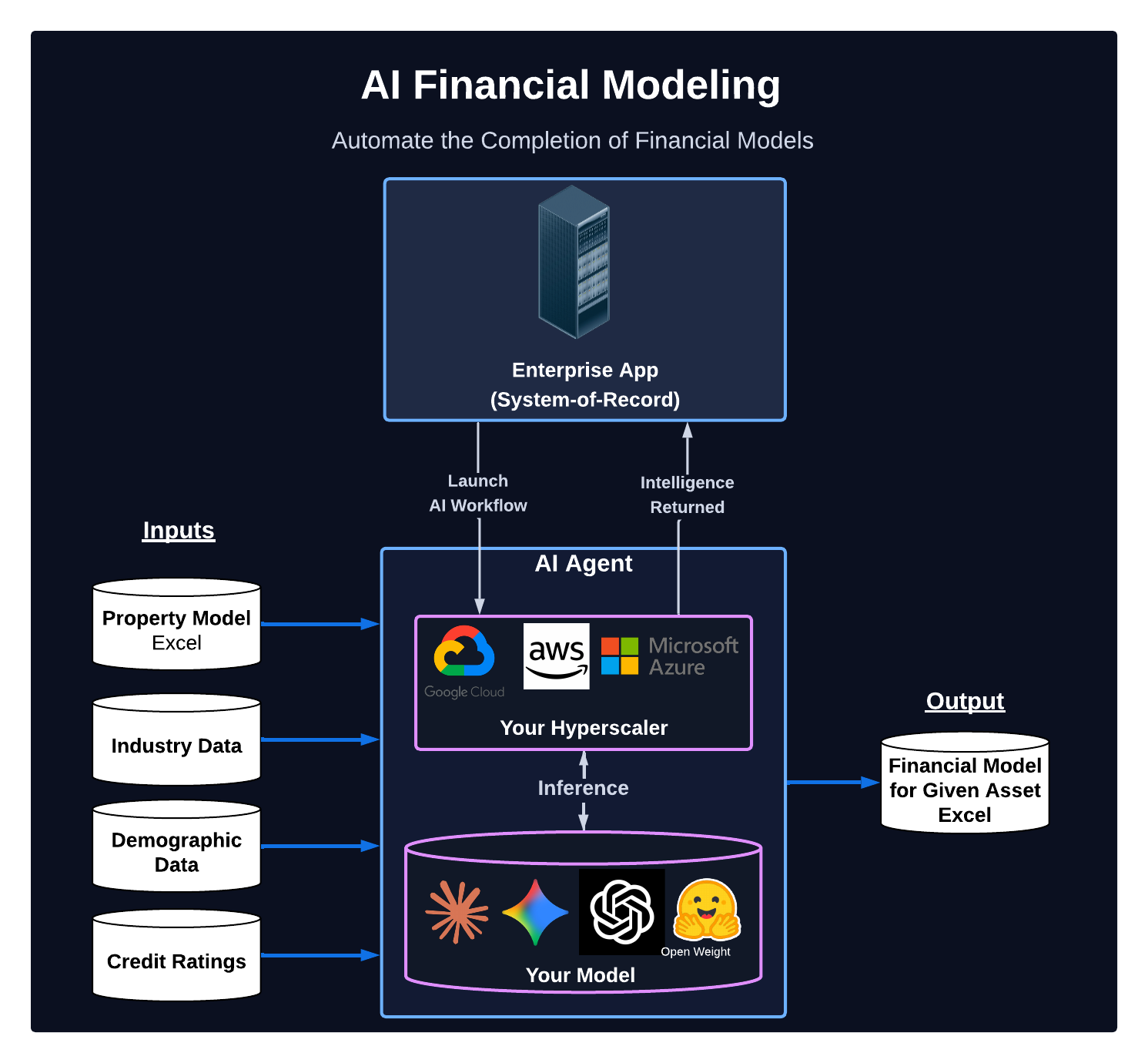
Encode your investment thesis
Your existing model and criteria are the specification. What you weight, what you disqualify, what a strong opportunity looks like — the system is built around your framework, not a generic one.
Assemble the data automatically
Property, market, demographic, financial, and credit data pulled from the sources your analysts already use, populated into the model structure your team already trusts.
Score, rank, and explain
AI produces the judgment-dependent output: scores against your criteria, comparative ranking across the pipeline, and written reasoning explaining the assessment. Deterministic calculations stay deterministic — the model math is computed, not generated.
Deliver in the format your team works in
Output arrives as the Excel model your organization already uses, with the narrative alongside it. No new tool for your analysts to adopt, and no change to how investment committee reviews are run.
Why This Approach
More opportunities evaluated
Analysis that consumed hours per property runs across the full pipeline, so opportunities are assessed against your actual thesis rather than screened out for lack of capacity.
Analysts on judgment, not assembly
Skilled staff stop populating spreadsheets and start interrogating results, pursuing the deals worth pursuing, and doing the work that requires their experience.
Decisions stay with your people
The system produces analysis and recommendations. Investment decisions remain with your team and your committee, with human review built into the workflow by design.
A defensible analytical record
Every score, ranking, and narrative traces back to its inputs and criteria — so any assessment can be explained to your committee, your investors, or a regulator.
Where this fits
- Screen and rank a large property or deal pipeline against a proprietary investment thesis
- Automate production of recurring investment analysis models at portfolio scale
- Generate consistent written assessments where narrative quality currently varies by author
- Standardize how opportunities are evaluated so your best analysts’ judgment scales across the team
Automate the analysis, not the decision.
This approach works because it separates two things that are easy to conflate. Calculations that should be deterministic are computed, not generated — AI is used for the judgment-dependent output, scoring and reasoning, where it genuinely adds value. And the investment decision itself stays with the people accountable for it. A system that quietly made allocation decisions would be a liability, however capable it was.