For seventeen years, Aptaria built its business inside Salesforce — implementing, integrating, and supporting CRM systems for organizations that needed those systems to actually work. As AI reshaped what enterprise clients needed, Aptaria rebuilt aptaria.com and its service offering around a new core discipline: enterprise AI strategy and implementation, grounded in two decades of experience getting complex systems into production.
Enterprise leaders have spent the last two years genuinely excited about AI. Most have also gotten stuck.
A compelling demo turns into a pilot. The pilot generates real interest. And then it stalls — not because the model failed, but because everything around the model wasn’t ready: data that wasn’t structured for it, no governance for when it’s wrong, no plan for how a legal or operations team would trust its output, no path from prototype to something people depend on every day.
Aptaria had already spent seventeen years solving a version of that exact problem for CRM and middleware. This was the same gap, wearing a new technology.
Opportunity: Repositioning Around What Clients Actually Needed
Aptaria’s Salesforce practice was strong, but the market question clients were asking had shifted. Increasingly, conversations that started about Salesforce ended up being about AI — and Aptaria needed a site and a service line that reflected where the real demand, and the real value, now sat.
Lead with AI, not bury it: restructure the site and messaging so enterprise AI strategy and implementation is the front-door identity, not a service buried under Salesforce consulting
Keep the credibility that took twenty years to earn: make the Salesforce and enterprise delivery heritage the foundation the AI positioning stands on, rather than something the pivot leaves behind
Prove it, don’t just claim it: anchor the new positioning in real delivered work — architecture, tradeoffs, outcomes — rather than the generic “AI transformation” language crowding the market
Take a look at our blog and other resources for more on our approach to solving problems like this.
Solution: A Site and Service Line Built Around Enterprise AI Delivery
Aptaria rebuilt aptaria.com around a single narrative: AI that ships, backed by twenty years of enterprise delivery discipline. That meant new structure, new frameworks made public for the first time, and a proof point built to do the convincing.
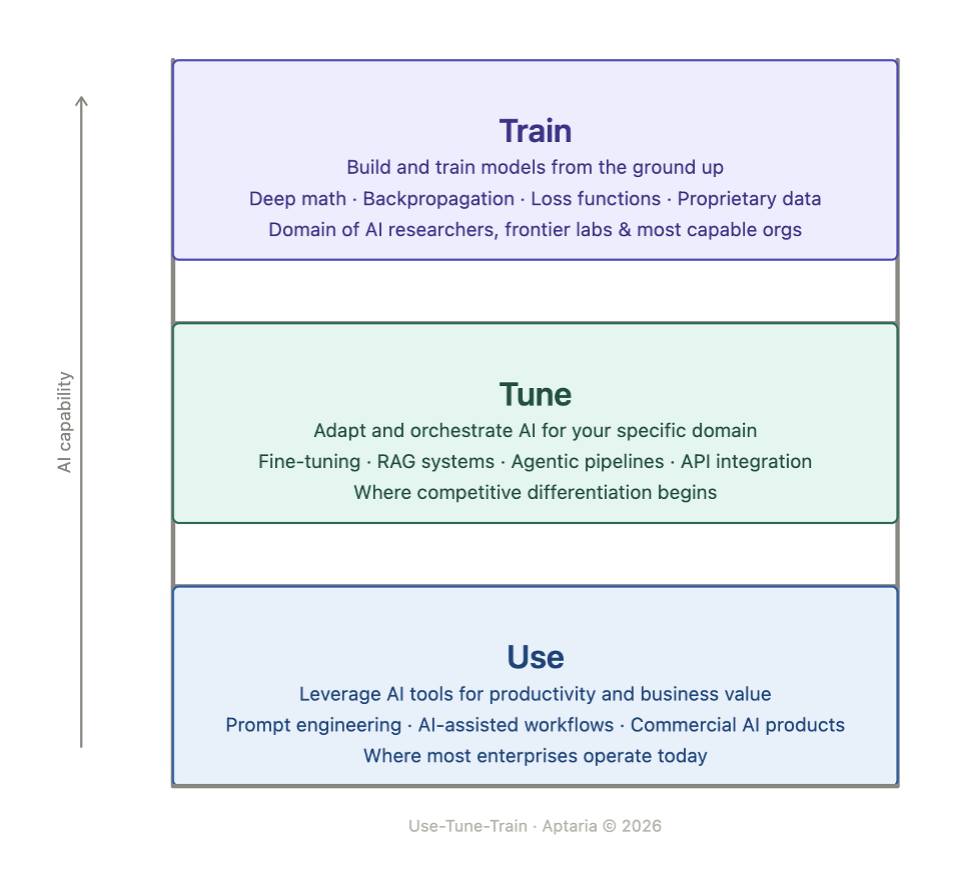
Use-Tune-Train Framework
Most organizations jump straight to asking whether they should train their own model, when the honest answer is usually that they haven’t finished using what already exists. Use-Tune-Train gives clients a way to place themselves accurately — using existing tools well, tuning models against their own data and workflows, or training and fine-tuning where the use case genuinely calls for it — instead of defaulting to the most expensive option because it sounds the most serious.
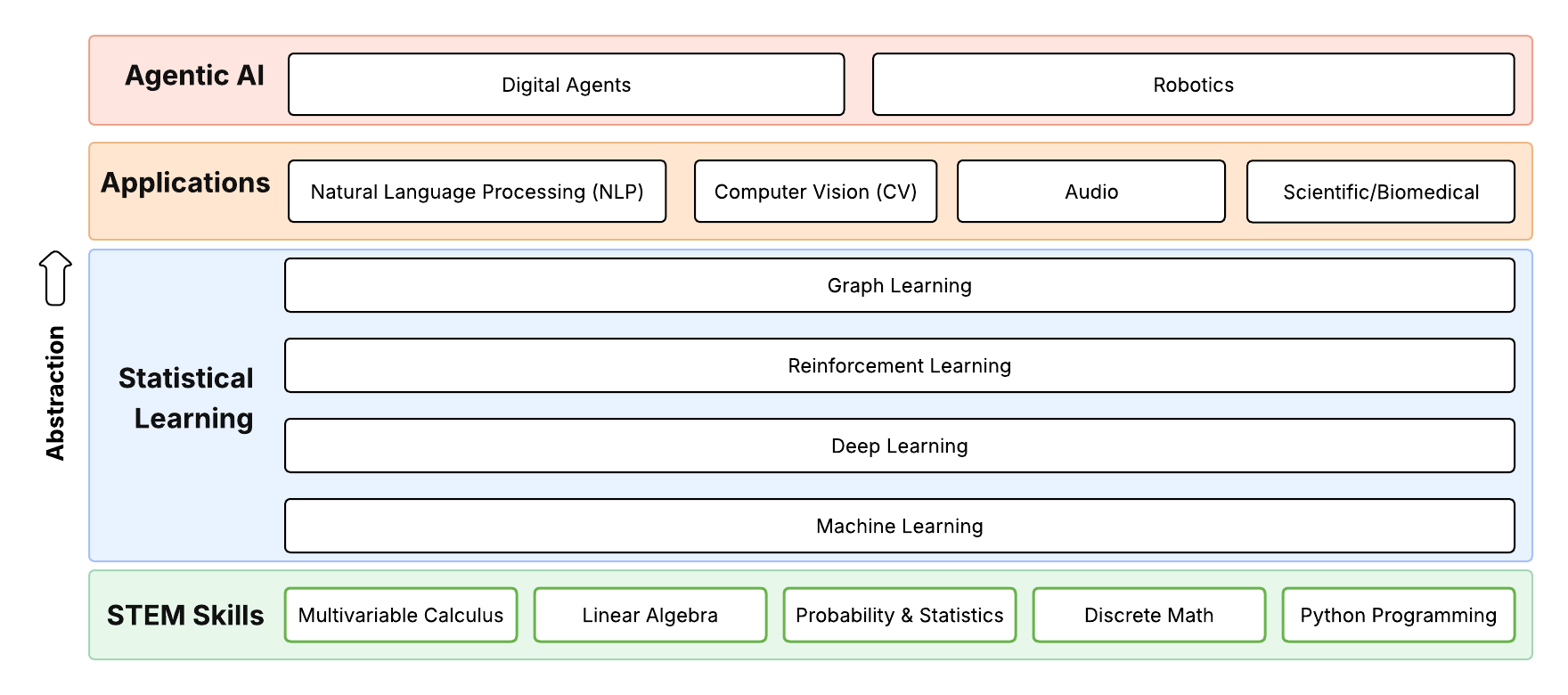
AI Skills Hierarchy
Alongside it, a layered pyramid lays out the capabilities an organization needs to build in sequence rather than all at once, giving clients and their teams a shared vocabulary for where they stand and what comes next.
A Real System, Not an Abstraction
Rather than lead with abstractions, the new site is built around a real delivered system: an agentic AI pipeline that automates investment analysis report generation across dozens of properties for a commercial real estate client, combining a reasoning layer, a data layer, and a computation layer into one production system. It’s presented as an example of a pattern — manual, document-heavy analyst work becoming AI-driven — that applies well beyond the industry it came from.
Partner-Backed Credibility
Direct partnerships with Anthropic, Google Cloud, AWS, and Salesforce sit behind the new positioning, giving clients frontier model access and enterprise cloud infrastructure alongside two decades of CRM and middleware delivery experience — a combination most AI-only or Salesforce-only firms can’t offer together.
Impact: A Site Built to Start the Right Conversation
The relaunched aptaria.com gives prospective clients, partners, and collaborators a clear, provable answer to what Aptaria does now — and why the Salesforce years matter to that answer rather than standing apart from it.
A credible AI-first identity: visitors see enterprise AI strategy and implementation as the lead offering, supported by real delivery history rather than generic transformation language
Original frameworks, publicly available: Use-Tune-Train and the AI skills hierarchy give prospects language to diagnose their own AI readiness before the first conversation even happens
A concrete proof point to point to: a real delivered engagement demonstrates what “enterprise-grade AI” looks like in production, not just in a pitch deck
Reach out to us if your organization is stuck somewhere between a promising AI pilot and something that actually runs.