Articles, Press Release
08/05/2026
Why We Rebuilt Aptaria for the AI Era
For seventeen years, Aptaria built its business inside Salesforce — implementing, integrating, and supporting CRM systems for organizations that needed…



July 16, 2026 | Andrew Lawlor
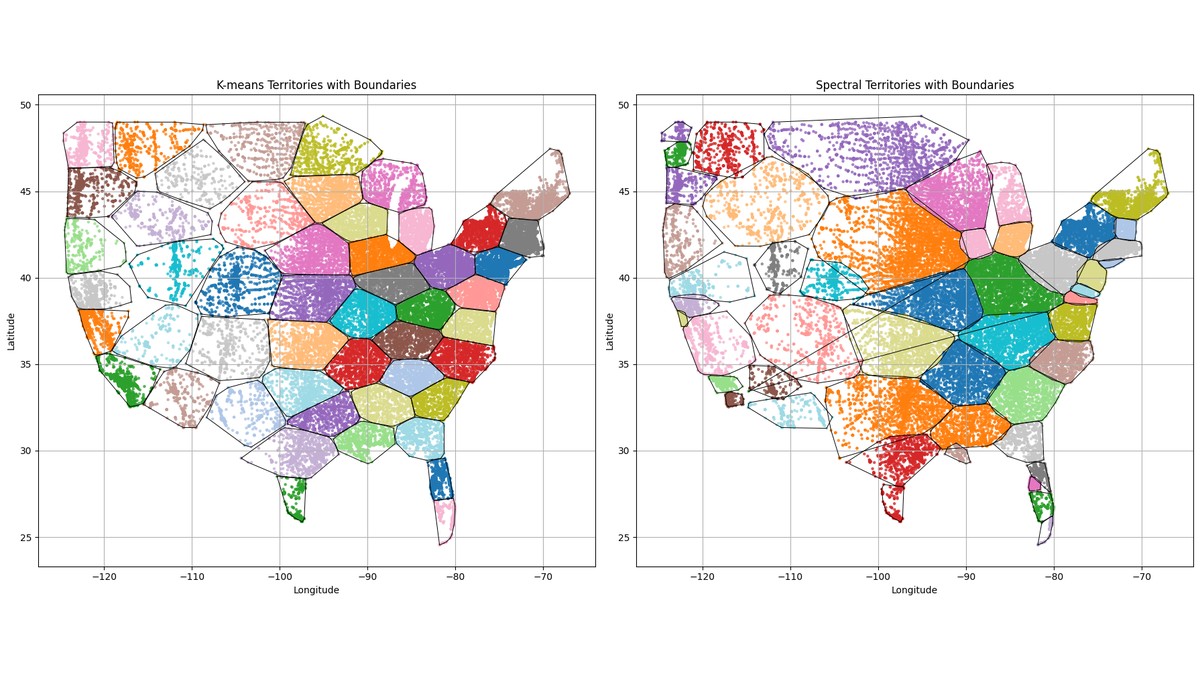
K-means outperformed spectral clustering on every standard metric — and produced territories no sales organization should use.
An analysis of 50-territory clustering across 71,000 commercial real estate properties in the lower 48 states, comparing K-means against spectral clustering. K-means scored better on Silhouette, Davies-Bouldin, and Calinski-Harabasz, but assumed spherical, equally-sized clusters — an assumption that breaks in dense metropolitan areas and produced territories badly unbalanced in account count. Spectral clustering responded to population density instead, allocating six territories in Florida where K-means drew four, with similar adjustments across the Bay Area, LA, the Mid-Atlantic, and the Northeast corridor. The broader lesson: when internal metrics diverge from the business outcome, question the metrics.
Read the full analysis (PDF) Related: Salesforce Territory Optimization
Conducted as part of graduate AI coursework at Stanford.